
Two key factors can be identified as the root causes of weakness and stagnation in the Muslim community:
- Political Despotism الاستبداد السياسي
This can be rendered in English as: Political Despotism, Political Tyranny, Authoritarianism, Autocracy, or Dictatorship.
Those who embody this trait are dictators. They are rulers who deny others any freedom, have no interest in or faith in consultation, and make decisions unilaterally and arbitrarily.
They brutally suppress their opponents. At times, they take the law into their own hands, imprison their rivals, and subject them to severe torture. They tailor their country’s education system to suit their own agenda and maintain total control over the media. To sustain their rule, they surround themselves with loyal enforcers who serve them, and they ensure these allies receive every form of support they need.
- Dogmatism / Stubbornness of Opinion الاستبداد بالرأي
This can be expressed in English as: Dogmatism, Authoritarianism, Stubbornness, or Arbitrariness.
These are not rulers. Instead, they captivate society with certain talents or charisma. Because of their outward appeal, society elevates them to positions of influence. As a result, they make critical decisions. They are often referred to as Key Opinion Leaders.[KOLs]
It should be noted that a small number of them are genuinely competent and deserving of their positions.
However, most operate with self-serving, worldly motives. It is this majority we are addressing here.
They refuse to listen to advice, and they have no desire to do so.
They believe only their own opinion is correct.
They assume that others know far less than they do.
When offered advice, they react with irritation. They brand anyone with a dissenting view as a ‘troublemaker’ or ‘rebel’.
Consumed by arrogance, they sit on their thrones and thunder their orders. They have even lost the basic judgment to know what should or should not be said. They silence others.
Therefore,
- Despotic rulers, and
- Dogmatic social leaders
These two groups have become the greatest obstacles to the progress of the Muslim community.
They may occasionally make the right decision, but more often than not, they make the wrong ones.
This results in two harmful outcomes:
- The society under their control faces humiliation and failure.
- They become targets of intense public criticism and condemnation.
In such cases, they waste enormous amounts of time and resources trying to justify themselves and suppress their critics.
They imagine they are loved by the people. But they only realize the truth when their situation deteriorates and even their closest flatterers and sycophants turn on them.
In the end, they are cast aside by the people. For betraying the trust of their responsibilities, they also incur the wrath of Allah.
The public too will be held accountable by Allah for appointing such unfit individuals and for tolerating their misconduct. Before entrusting someone with authority, society must carefully assess their qualifications, competence, and character.
A society that appoints an unqualified person to a position of responsibility has committed a sin. It will inevitably suffer the consequences of that person’s errors. If, after appointment, that person abuses their power, it is the society’s duty to remove them from office with courage.
Anyone who assumes a position of responsibility must first determine whether they are truly fit for it. If not, they should not take it on at all, because it is a sacred trust.
However, if someone believes they are qualified, there is nothing wrong with seeking the role, just as Prophet Yusuf [AS] did. But once in office, they must equip themselves fully for the task and carry out their duties with God-consciousness and sincere intention.
It is also essential for those in authority to consult qualified experts whenever important matters arise.
The Islamic Perspective on Shura [Consultation]
Because a society without Shura is destined for decline, Allah’s religion commands us to consult one another in significant affairs.
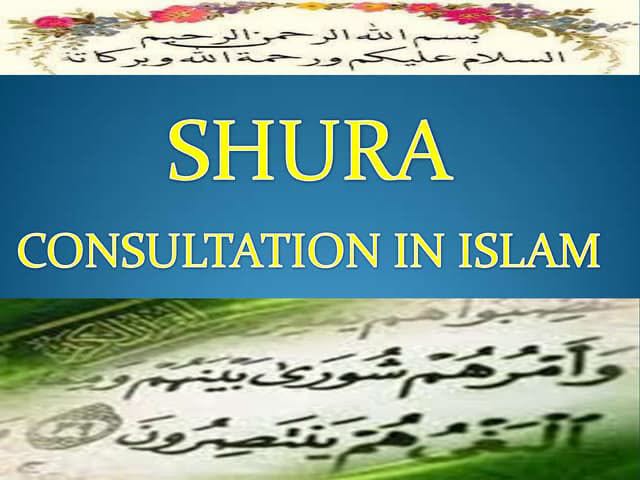
Allah says in the Qur’an: _“…and conduct their affairs by mutual consultation…”_ [42:38]. This shows that consultation and collective effort are among the defining characteristics of the Muslim community.
Allah also instructed His Prophet: _“…and consult them in the matter…”_ [3:159].
The Prophet [SAW] possessed such immense wisdom that he did not need others’ counsel. Yet even while revelation was being sent down, he still sought the advice of his Companions. If he did so, then what about us?
It is also important to note that he consulted them not on matters of divine command, but on the best methods of implementation. He especially sought counsel when dealing with other communities.
A hadith in Sahih al-Bukhari records that during the Treaty of Hudaybiyyah, when a critical situation arose, the Prophet [SAW] took the advice of his wife Umm Salamah [RA] and based his key decision on it.[2731]
Shura is necessary even in the smallest matters of daily life. Allah states that even in weaning a child, a husband and wife must consult and agree with one another:
“And if they both desire weaning through mutual consent and consultation, there is no blame upon either of them…”[2:233]
If a couple must consult before weaning their child, how much more consultation and depth is required for major issues that determine the fate of an entire community?
If consultation is essential even within the small unit of a family, then in the foundational areas of a society — politics, economics, security, and social relations — decisions must be made only after extensive consultation and research.
Before deciding on major issues, experts and specialists must be consulted. What one person knows, another may not. The experience of seasoned individuals is invaluable in consultation. When many perspectives are gathered and an issue is examined from multiple angles, the best possible decision can be reached.
If research, data, or statistics are needed, they must be commissioned. Decisions made with foresight and based on such foundations carry barakah They earn Allah’s pleasure. And because the responsibility is shared, one individual does not have to bear all the criticism alone.
Yet today, if we look at society, this practice of consultation has largely disappeared. That is why we are witnessing such widespread decline.
Imam Al-Qurtubi [RA] reports from Ibn Atiyyah in his Tafsir: “Shura is one of the fundamental principles and established legal maxims of the Shariah. It is obligatory to remove from authority anyone who does not consult people of knowledge and piety. There is no scholarly disagreement on this.”
Ibn Quways Mindad [RA] also said:
“It is obligatory for rulers to consult scholars regarding matters they do not know and religious issues that are complex for them.
They must consult military experts on matters of war, public representatives on matters of public interest, and writers, ministers, and administrators on matters of national welfare and development.”
Our predecessors also stressed the importance of consultation with sayings such as: _“One who consults will never regret,”_ and _“One who is enamored with his own opinion will go astray.”_
Therefore, Shura — consultation — is a fundamental principle, a distinctive trait, and a religious obligation of the Islamic community.
May we recognize the vital importance of consultation at every level of society and act upon it for our collective rise and progress.
*Ash-Sheikh S.H.M. Faleel*


